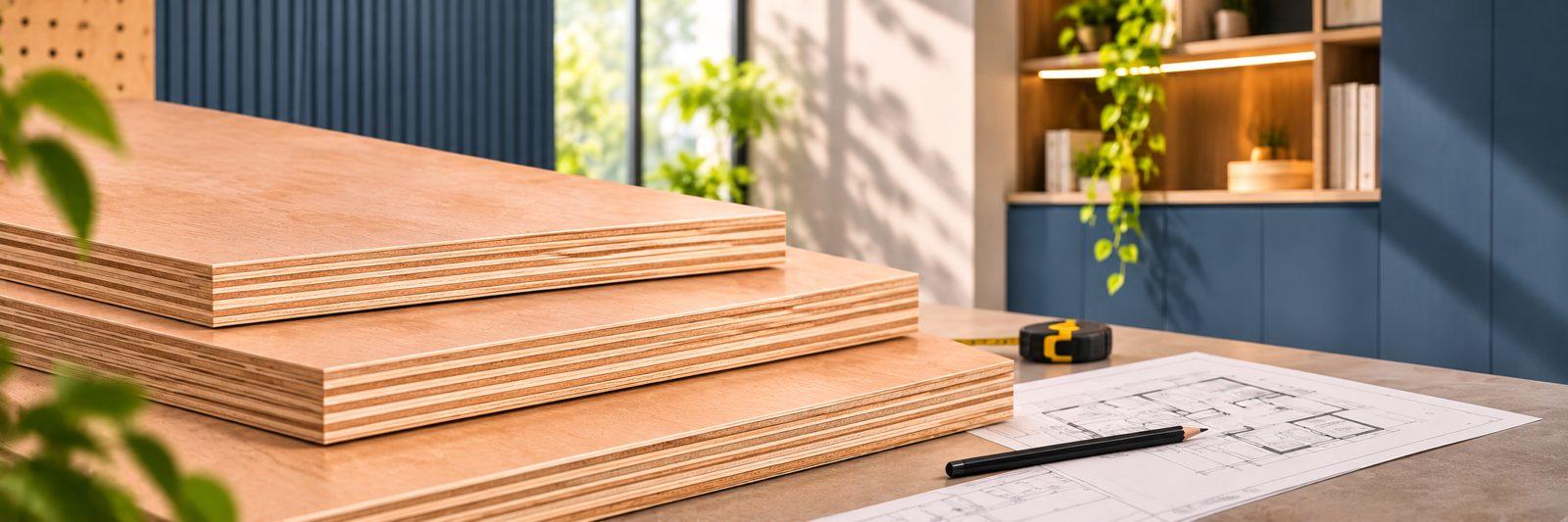
Know Your Materials
What is Calibrated Plywood and its Applications in Modular Interiors
27 Nov 2026 · Kyzo
Precision plays an important role in modular furniture manufacturing. From kitchen cabinets and wardrobes to storage units and office furniture, every component needs to fit accurately for a clean finish and efficient installation. This is where calibrated plywood becomes useful. Unlike conventional plywood, calibrated plywood is sanded and processed to achieve more uniform thickness across the sheet. This consistency makes it easier for furniture manufacturers, carpenters and interior contractors to work with precise measurements during fabrication.
But what exactly makes calibrated plywood suitable for modular interiors, and where can it be used? Let's explore its features, benefits and applications.
What Is Calibrated Plywood?
Calibrated plywood is plywood that undergoes controlled sanding and thickness calibration to achieve a more uniform thickness across its surface. During the calibration process, the sheet is passed through specialised sanding equipment to reduce thickness variations and create a more consistent surface.
This is particularly useful in modular furniture production, where multiple panels need to align accurately during cutting, assembly and installation.
Key Benefits of Calibrated Plywood
1. Uniform Thickness Across the Sheet
One of the main advantages of calibrated plywood is its consistent thickness. When plywood sheets have variations in thickness, they can create difficulties during furniture fabrication, particularly when several panels need to align. Calibrated plywood helps reduce these variations, making it easier to maintain consistent dimensions across furniture components.
2. Smoother Surface for Finishing
The calibration and sanding process creates a more even surface, which can help when applying laminates, veneers and other decorative finishes. A consistent surface also makes it easier to achieve a uniform appearance across cabinet panels, wardrobe shutters and other furniture components.
The final finish will still depend on surface preparation, adhesive selection and installation quality.
3. Greater Precision in Modular Furniture Manufacturing
Modular furniture relies on accurately measured components that fit together during assembly. Using plywood with more consistent thickness can help manufacturers maintain better dimensional consistency across panels. This is especially useful when producing multiple cabinet units, drawers, shelves and wardrobe components.
4. More Predictable Fabrication and Installation
Thickness variations can require additional adjustments during cutting, edge finishing and assembly. Calibrated plywood helps reduce the need to account for inconsistent sheet thickness, making fabrication and installation more predictable. However, calibration alone does not eliminate issues such as warping, core gaps or delamination. Overall plywood quality and proper handling remain important.
Applications of Calibrated Plywood in Modular Interiors
Calibrated plywood can be used across several residential and commercial furniture applications, depending on its grade, thickness and specifications.
Kitchen Cabinets: Suitable for selected cabinet carcasses, shelves and other kitchen furniture components. The choice of plywood grade should account for the moisture conditions in the kitchen.
Wardrobes and Storage Units: Uniform thickness can help maintain consistent panel dimensions across wardrobe carcasses, shelves, partitions and storage compartments.
Modular Shelving: Calibrated sheets can be used for shelving and storage systems where consistent panel thickness is important for fabrication and alignment. Shelf span, loading and support should also be considered.
Office Furniture: Desks, workstations, storage cabinets and partitions are some of the applications where calibrated plywood can support consistent fabrication.
Custom Furniture: For beds, tables, TV units and other made-to-measure furniture, consistent sheet thickness can help simplify cutting, assembly and finishing.
Calibrated Plywood vs Regular Plywood
Both calibrated and regular plywood can be used for furniture manufacturing. The key difference is the thickness consistency achieved through the calibration process.
Feature | Calibrated Plywood | Regular Plywood |
|---|---|---|
Thickness | More uniform across the sheet | May have greater thickness variation |
Surface | Sanded for a more consistent surface | Depends on the product and sanding quality |
Fabrication | Useful for precision-based furniture work | May require adjustments for thickness variations |
Applications | Modular furniture and precision-based interiors | General furniture and interior applications |
The right choice depends on the project's fabrication requirements, product specifications and budget.
What Should You Check Before Buying Calibrated Plywood?
Before purchasing calibrated plywood for a modular interior project, consider the following:
Thickness: Select the required thickness based on the furniture component and intended load.
Plywood grade: Choose MR, BWR or BWP according to the expected moisture exposure and application.
Surface quality: Check whether the sheet has a consistent and suitable surface for the intended finish.
Core construction: Inspect the edges and ask about the core composition and quality.
Brand and specifications: Review the manufacturer's product details, relevant standards and warranty conditions.
Calibration consistency: Check the thickness at different points across the sheet where possible.
Calibration is one aspect of plywood quality. The core, bonding, grade and overall construction also influence how the board performs.
Conclusion
Calibrated plywood is a practical option for modular furniture manufacturing, where consistent thickness and accurate dimensions help simplify fabrication, assembly and installation. From kitchen cabinets and wardrobes to office furniture and custom storage units, it can support more predictable production when selected according to the project's requirements.
For designers, carpenters and furniture manufacturers, the important thing is to look beyond thickness alone. Consider the plywood grade, core construction, surface quality and manufacturer specifications before making a purchase.
Calibrated Plywood
See AllFAQs
What is calibrated plywood used for?
Calibrated plywood is commonly used in modular kitchens, wardrobes, storage units, office furniture, shelving and custom furniture where consistent sheet thickness is useful.
What is the difference between calibrated and non-calibrated plywood?
Calibrated plywood undergoes controlled sanding to achieve more uniform thickness across the sheet. Non-calibrated plywood may have greater thickness variations, depending on its manufacturing process.
Is calibrated plywood suitable for modular kitchens?
Yes, it can be used for selected kitchen cabinet components. The appropriate plywood grade should be chosen based on moisture exposure and the specific application.
Where can I buy calibrated plywood in Bangalore?
You can explore plywood options from Khidki and other established brands on KYZO for modular furniture, kitchen, wardrobe and interior projects.