Product Spotlight
What Are Calibrated Blockboards and Why Interior Contractors Prefer Them
26 Nov 2026 · Kyzo
When it comes to building large wardrobes, tall shutters, partitions and furniture panels, choosing the right board is essential. These applications require materials that offer structural stability, consistent thickness and a suitable surface for finishing. One material worth considering is calibrated blockboard.
Unlike conventional blockboards, calibrated blockboards undergo machine sanding to achieve more uniform thickness and smoother surfaces. This makes them useful for furniture applications where consistent dimensions are important during lamination, cutting, edge banding and installation.
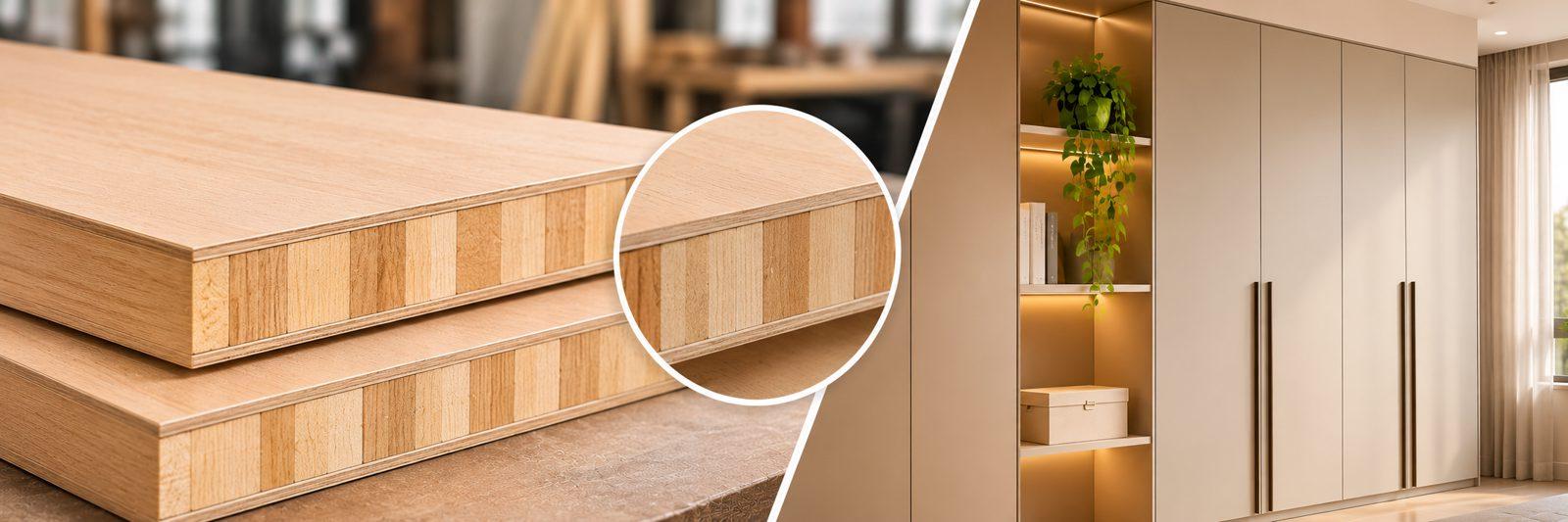
Blockboards also have a distinct core construction. They are made using solid wood strips or battens arranged edge to edge and sandwiched between veneer layers. This construction makes them particularly useful for certain long-panel and furniture applications.
For interior contractors, carpenters and modular furniture manufacturers, understanding the difference between regular and calibrated blockboards can help in selecting suitable materials for different projects.
Let's explore how calibrated blockboards are manufactured, their key advantages and where they are commonly used.
What Is a Calibrated Blockboard?
Blockboard is an engineered wood panel made using a core of solid wood battens placed side by side, with veneer layers bonded to both surfaces. In calibrated blockboards, the finished panel undergoes machine sanding to achieve more consistent thickness across its surface. This process helps reduce surface variations and provides a more uniform substrate for further processing and finishing.
Calibrated blockboards are commonly considered for:
Large wardrobe shutters.
Tall furniture panels.
Partitions and storage units.
Flush doors.
Furniture components requiring long panels.
Key Advantages of Calibrated Blockboards
1. More Uniform Thickness and Surface Finish
One of the main advantages of calibrated blockboards is their more consistent thickness. This is useful when multiple panels need to be cut, aligned and assembled within the same furniture structure.
Benefits include:
More consistent panel dimensions.
Reduced need for manual surface levelling.
A smoother substrate for laminate application.
Better consistency during furniture assembly.
However, calibration does not eliminate all surface imperfections or guarantee that a board will remain completely flat under every condition.
2. Suitable for Large Shutters and Furniture Panels
Blockboards are commonly used for larger furniture components because of their solid wood strip core construction. They can be considered for applications such as:
Tall wardrobe shutters.
Loft shutters.
Bedroom and living room partitions.
Large storage panels.
Flush doors and furniture components.
The suitability of a blockboard for a particular shutter depends on its dimensions, core construction, thickness, support and hardware arrangement. Proper installation is important to minimise bending or movement over time.
3. Supports Better Lamination and Finishing
A more uniform surface can make calibrated blockboards suitable for decorative finishing. They can be paired with different surface materials depending on the furniture design. Proper surface preparation, adhesive selection and pressing conditions are still essential for achieving a good laminate finish.
4. Helps Improve Fabrication Efficiency
In furniture manufacturing, inconsistent board dimensions can lead to additional adjustments during cutting, fitting and assembly. Calibrated blockboards provide more consistent thickness, which can help simplify fabrication and reduce repeated manual corrections.
They can be useful for:
Modular wardrobe manufacturing.
Large furniture batches.
Flush door production.
Partition fabrication.
Projects involving multiple matching panels.
The final processing quality also depends on the cutting equipment, tools, board construction and workmanship.
Where Are Calibrated Blockboards Commonly Used?
Application | Typical use |
|---|---|
Wardrobes | Large shutters and panels |
Loft storage | Loft shutters |
Partitions | Interior dividing panels |
Flush doors | Door core construction |
Bedroom furniture | Headboards and large panels |
Living room furniture | Storage and decorative panels |
The appropriate grade and thickness should be selected according to the installation environment and product specifications.
Calibrated Blockboard vs Regular Plywood
Blockboard and plywood have different core constructions, so the choice depends on the intended application.
Feature | Calibrated Blockboard | Plywood |
|---|---|---|
Core construction | Solid wood battens | Cross-laminated veneer layers |
Surface uniformity | Machine-calibrated | Depends on manufacturing and calibration |
Common applications | Large panels, shutters and doors | General furniture and structural panels |
Lamination | Suitable with proper preparation | Suitable with proper preparation |
Material selection | Depends on core quality and grade | Depends on plywood grade and construction |
Neither material is universally better. The right choice depends on panel size, load requirements, moisture exposure, furniture design and installation conditions.
Conclusion
Calibrated blockboards are worth considering for furniture applications where consistent thickness, large panel dimensions and a suitable finishing surface are important. From wardrobe shutters and partitions to flush doors and storage panels, their solid wood strip construction offers a different set of properties compared with conventional plywood. For contractors and furniture manufacturers, selecting the right blockboard grade, thickness and construction can help improve fabrication consistency and achieve a better-finished product.
Blockboard
See AllFAQs
What is the difference between regular and calibrated blockboard?
Regular blockboard may have greater thickness variations depending on manufacturing. Calibrated blockboard undergoes machine sanding to achieve more uniform thickness and a smoother surface.
Are calibrated blockboards suitable for tall wardrobe shutters?
They can be considered for tall wardrobe shutters because of their solid wood strip core construction. However, suitability depends on board thickness, shutter dimensions, support and hinge arrangement.
Can I order blockboards and laminates together on KYZO?
Yes. KYZO brings together blockboards, plywood, decorative laminates, liner laminates, MDF and other interior materials from Khidki and established brands, helping you explore materials for the same project.
What is the difference between MR and BWP blockboard?
MR blockboard is intended for normal interior conditions, while BWP blockboard is designed for applications requiring greater moisture resistance. The appropriate grade depends on the expected exposure and product specifications.