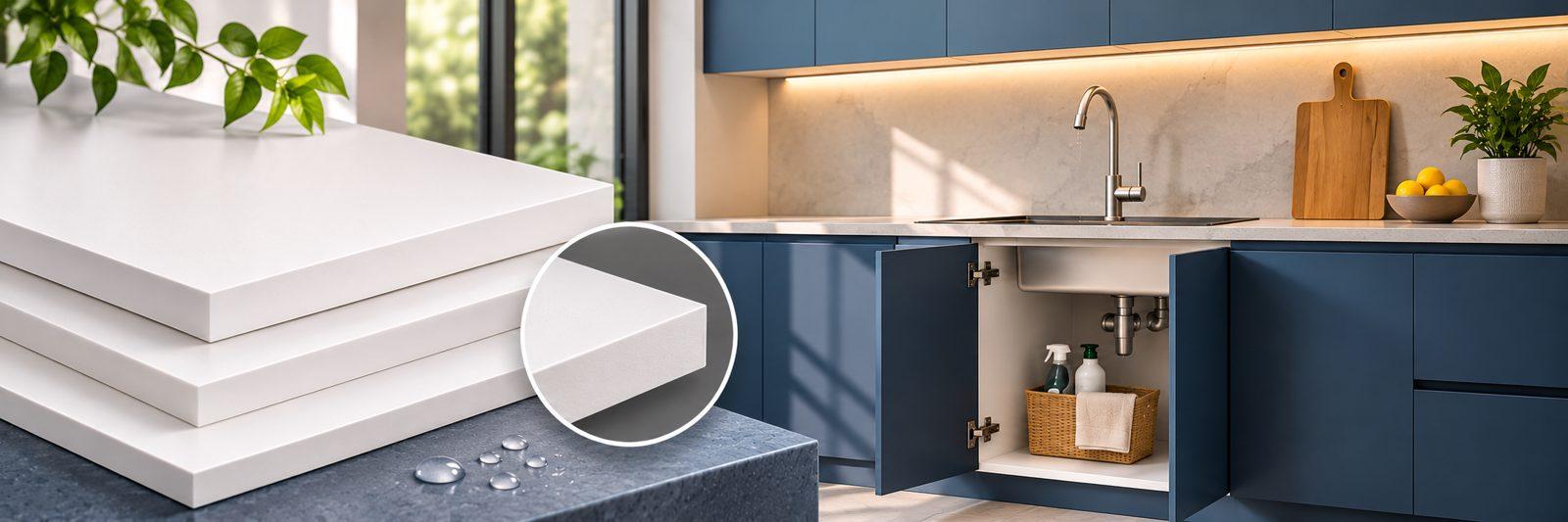
Product Spotlight
PVC Boards are Disrupting Kitchens – Here's Why Carpenters Are Switching from Plywood
25 Nov 2026 · Kyzo
Kitchen furniture is regularly exposed to moisture, spills, cleaning and everyday use. While plywood has traditionally been a popular choice for kitchen cabinets, designers and carpenters are increasingly exploring alternative materials for areas where moisture resistance is particularly important.
One such option is PVC board. Made from polyvinyl chloride, PVC boards are non-wood-based panels that offer moisture-resistant properties and are not susceptible to termite attacks in the same way as wood-based materials. These characteristics make them worth considering for selected kitchen furniture applications, particularly under-sink cabinets, utility storage and other moisture-prone areas.
1. What Are PVC Boards?
PVC boards are rigid panels made from polyvinyl chloride, a synthetic polymer. Unlike plywood, which is manufactured using layers of wood veneer, PVC boards are made from plastic-based material. They are available in different thicknesses, densities and finishes depending on the manufacturer and product range.
Some general characteristics include:
Moisture Resistance: PVC boards do not absorb water like conventional wood-based boards.
Termite Resistance: Their inorganic composition makes them unsuitable as a food source for termites.
Lightweight Construction: Many PVC board variants are relatively lightweight and can be convenient to handle.
Easy Maintenance: Their surface can generally be cleaned with suitable cleaning methods.
Alternative to Wood-Based Panels: They can be considered for selected furniture applications where moisture exposure is a concern.
The actual strength, rigidity and load-bearing performance depend on the board's composition, density and manufacturing quality.
2. Why Are Carpenters Considering PVC Boards for Kitchens?
PVC boards offer certain advantages that make them worth evaluating for kitchen furniture, particularly in areas exposed to moisture.
1. Resistance to Termite Attacks
Unlike wood-based materials, PVC boards do not contain cellulose, which termites feed on. This makes them resistant to termite attacks. They can therefore be considered for furniture applications where termite exposure is a concern. However, building-level termite management is still important because surrounding wooden components may remain vulnerable.
2. Moisture Resistance
One of the main reasons PVC boards are considered for kitchen applications is their resistance to water absorption. They can be useful for under-sink cabinets, utility storage and other areas where occasional water exposure is expected. However, joints, fittings and surrounding materials should also be protected against moisture.
3. No Separate Lamination Required for Some Applications
Depending on the product, PVC boards may be used with their existing surface finish without applying a separate decorative laminate. This can reduce certain finishing steps. Additional surface treatments or decorative finishes may still be required depending on the desired appearance.
4. Convenient Fabrication
PVC boards can be cut and fabricated using suitable tools and processes. However, machining methods, screw fixing and hardware installation should follow the manufacturer's recommendations, as PVC boards behave differently from plywood and MDF.
5. Suitable for Selected Wet-Area Applications
For furniture components that experience regular moisture exposure, PVC boards offer an alternative to conventional wood-based panels. Their suitability should be evaluated based on the required strength, thickness, density and hardware compatibility.
3. Where Can PVC Boards Be Used in Kitchen Interiors?
PVC boards are not necessarily a replacement for plywood across an entire kitchen. Their properties make them particularly relevant for selected applications.
Under-Sink Cabinets: The area below the kitchen sink is more likely to experience water splashes or plumbing leaks. PVC boards can be considered for suitable cabinet components in this location.
Utility Storage: Utility areas may experience greater moisture exposure than other parts of the home. PVC boards can be evaluated for selected storage applications.
Kitchen Drawer Components: Certain drawer components can be made using suitable PVC boards, provided the material meets the required load and hardware-fixing specifications.
Loft and Storage Units: PVC boards can be considered for selected storage applications where their weight, rigidity and fixing characteristics are appropriate.
Bathroom Vanities: Their moisture-resistant properties also make PVC boards worth considering for suitable bathroom vanity furniture.
For outdoor kitchens or exposed balcony furniture, check the manufacturer's suitability and performance specifications before use.
4. PVC Boards vs Plywood: Which Should You Choose?
Both materials have different characteristics and applications. The right choice depends on the furniture component and its functional requirements.
Feature | PVC Boards | Plywood |
|---|---|---|
Material | Plastic-based | Wood veneer-based |
Termite Resistance | Inherently resistant to termite attack | Depends on treatment and product specifications |
Moisture Resistance | Does not absorb water like wood-based boards | Depends on plywood grade |
Weight | Varies by density and construction | Varies by wood species and construction |
Surface Finish | Depends on the board variant | Can be finished with decorative laminates |
Hardware Fixing | Requires suitable fixing methods | Depends on plywood construction and quality |
Applications | Selected wet-area and storage furniture | Wide range of structural and furniture applications |
PVC boards and plywood should not be treated as interchangeable materials in every situation. Plywood may be more suitable for certain structural and hardware-intensive furniture components, while PVC can be useful in selected moisture-prone applications.
5. Explore PVC Boards on KYZO
For carpenters, interior designers and modular furniture manufacturers, selecting the right board for each furniture component can make material planning more effective. PVC Boards are available through KYZO for customers exploring alternatives to conventional wood-based panels.
The range includes white PVC board options in different specifications. Buyers can compare the available density and thickness options to identify products suitable for their intended applications.
KYZO brings together interior materials from its private label, Khidki, and other established brands, helping customers explore plywood, MDF, HDMR, PVC boards and decorative laminates for different furniture requirements.
PVC WPC Board
See All
Final Thoughts
PVC boards offer an alternative to traditional wood-based materials, particularly for selected furniture applications where moisture resistance and termite resistance are important considerations. From under-sink cabinets and utility storage to bathroom vanities, they can be useful when selected according to the application's structural and fabrication requirements.
However, PVC boards are not a universal replacement for plywood. Understanding the differences in strength, rigidity, hardware fixing and fabrication requirements is essential before making a decision.
The best approach is to choose the right material for each furniture component rather than using the same board throughout the project.
FAQs
What are PVC boards used for in kitchens?
PVC boards can be considered for under-sink cabinets, utility storage and selected kitchen furniture components where moisture resistance is important.
Can PVC boards replace plywood in kitchen cabinets?
They can replace plywood in selected applications, but not necessarily every component. The choice depends on structural requirements, load, hardware fixing and fabrication methods.
Are PVC boards suitable for bathroom vanities?
They can be considered for suitable bathroom vanity applications because of their moisture-resistant properties. Structural requirements and installation details should still be evaluated.
Where can I explore PVC boards in Bangalore?
You can explore PVC board options through KYZO and compare available product specifications for your furniture project.