Know Your Materials
From Factory to Site – What Designers Should Know About Material Wastage, Warping & Core Gaps
24 Nov 2026 · Kyzo
A furniture project can look perfect on paper, but the real test begins when materials reach the factory and fabrication starts. Issues such as uneven board thickness, internal core gaps, warping and inconsistent density can create challenges during cutting, edge finishing, lamination and installation. What initially appears to be a small material-quality issue can eventually lead to additional work, material wastage and delays at the project site.
For interior designers, architects and carpenters, understanding these problems before purchasing materials can make a significant difference to the execution process.
In this guide, we look at common board-quality issues, why they matter during furniture fabrication and what to consider when selecting plywood and HDMR boards.
1. Common Material Problems That Affect Furniture Fabrication
Some material defects are difficult to identify from the finished surface of a board. However, they can become noticeable during cutting, machining and installation.
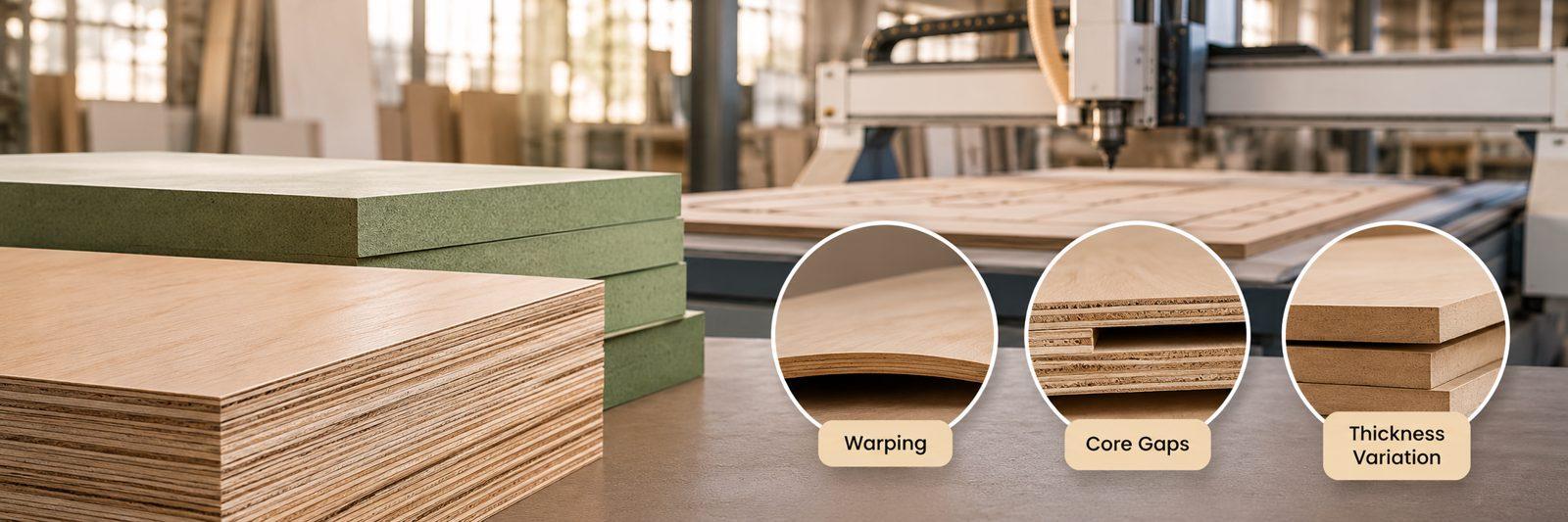
Warping in Plywood Sheets: Warping refers to a sheet bending or losing its flat shape. It can make handling, cutting and alignment more difficult, particularly when working with larger panels and precision furniture components.Possible effects include:
Difficulty positioning sheets accurately during cutting.
Alignment challenges during assembly.
Uneven surfaces in finished furniture.
Core Gaps in Plywood: Plywood is manufactured using multiple layers of wood veneers. Gaps or voids within the core can affect the consistency of the internal construction. Potential issues include:
Chipping or uneven edges during cutting.
Weak spots in certain sections of the sheet.
Difficulties when fixing screws or hardware near affected areas.
Checking the internal construction and exposed edges can help identify visible defects before fabrication.
Inconsistent Board Thickness: Uniform thickness is important when working with modular furniture components. Variations in thickness can create challenges during:
CNC cutting and machining.
Laminate application.
Edge finishing and alignment.
Assembly of adjoining furniture components.
Inconsistent Board Density: Density can influence the machining and fixing characteristics of MDF and HDMR boards. Boards with unsuitable or inconsistent density may affect cutting quality, edge finishing and screw-holding performance. The appropriate density should be selected according to the intended application and product specifications.
2. Why Calibrated Materials Matter
Calibration is a process used to bring a board to a more uniform thickness through controlled machine processing. Calibrated plywood and boards can be useful in furniture manufacturing because consistent thickness helps simplify several fabrication activities. Some potential benefits include:
More Consistent Thickness: Helps maintain uniform dimensions across furniture components.
Better Fabrication Planning: Makes it easier to work with specified dimensions during cutting and machining.
Improved Surface Preparation: Provides a more consistent base for suitable laminating and finishing processes.
Assembly Consistency: Helps reduce thickness-related alignment variations between adjoining components.
However, calibration alone does not guarantee that a board is free from warping, core gaps or other internal defects. Overall material quality and manufacturing standards remain important.
3. How Material Quality Affects CNC Cutting and Lamination
Modern furniture manufacturing increasingly relies on CNC machines and precision fabrication processes. The quality and consistency of the board being processed can influence the final result.
During CNC Cutting: Uneven thickness, internal voids or warped sheets can create machining challenges. The board should be suitable for the machine settings, cutting method and furniture component being manufactured.
During Edge Finishing: The condition of the board edges affects the quality of edge banding and other finishing processes. Internal gaps or chipped edges may require additional preparation before finishing.
During Lamination: A consistent and properly prepared substrate is important for achieving an even decorative surface. Surface irregularities, dust and unsuitable adhesive application can affect the final finish.
During Hardware Installation: The board's density and screw-holding characteristics matter when installing hinges, channels and other furniture hardware. Always check that the selected board is suitable for the hardware and loading requirements.
4. Choosing the Right Material for Different Applications
Different furniture applications require different material properties. Rather than selecting one board for every component, consider the intended use, moisture exposure and fabrication requirements.
Calibrated BWP Plywood
BWP-grade plywood can be considered for kitchen furniture and other applications where greater moisture resistance is required. Its suitability depends on the product specifications, construction and installation. It is important to remember that BWP plywood does not make the entire finished furniture unit waterproof.
BWP 710 Plywood
See AllCalibrated MR Plywood
MR-grade plywood is generally considered for interior furniture applications that do not experience prolonged or direct water exposure. It can be evaluated for wardrobes, bedroom furniture and other suitable indoor applications, depending on the product specifications.
Calibrated Plywood
See AllHDMR Boards
HDMR boards can be considered for selected modular furniture applications where a dense, uniform board is required. They are commonly evaluated for furniture components involving machining, decorative finishing and suitable CNC applications. Check the board's density, thickness and fabrication recommendations before specifying it. HDMR is moisture-resistant, not waterproof.
HDMR Boards
See All5. Explore Calibrated Plywood and Boards on KYZO
Selecting the right material is an important part of keeping furniture fabrication and site execution organised. KYZO brings together interior materials from its private label, Khidki, and other established brands. Designers, contractors and furniture manufacturers can explore calibrated plywood, MDF and HDMR boards for different furniture applications.
Whether you are planning kitchen cabinets, wardrobes or customised modular furniture, comparing product grades, dimensions and specifications can help you make informed material decisions.
Final Thoughts
Material quality has a direct influence on the furniture fabrication process. Issues such as warping, core gaps, inconsistent thickness and unsuitable board density can create additional challenges during machining, finishing and installation. For designers and carpenters, the solution begins with selecting materials suited to the application and checking their condition before fabrication. Calibrated boards can help provide more consistent thickness, but they should be evaluated alongside the overall construction, surface quality and technical specifications of the product.
A little attention to material selection at the beginning can help make the journey from factory to site more predictable.
FAQs
What is material warping in plywood?
Warping occurs when a plywood sheet bends or loses its flat shape. It can make cutting, alignment and furniture assembly more challenging.
What are core gaps in plywood?
Core gaps are voids or spaces within the internal veneer construction of plywood. They can affect the consistency of the board and may become noticeable during cutting or edge finishing.
Does calibrated plywood guarantee zero core gaps?
No. Calibration helps improve thickness uniformity but does not independently guarantee a void-free core. Internal construction quality must be evaluated separately.
Which plywood is suitable for kitchen furniture?
BWP-grade plywood may be considered for kitchen applications where greater moisture resistance is required. The final choice should depend on the specific furniture component and expected moisture exposure.